
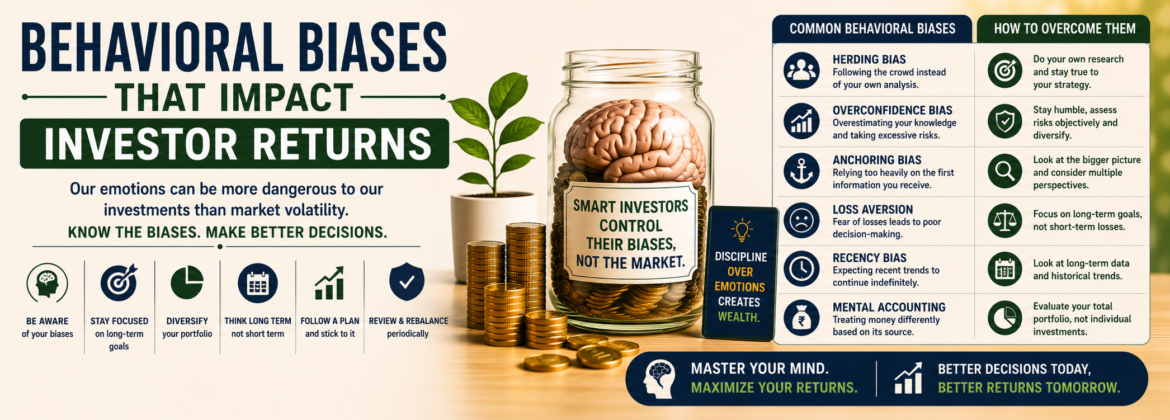
Behavioral Biases That Impact Investor Returns: Understanding the Psychology of Investing
Many investors wonder why they often earn lower returns than the long-term potential of their investments. Surprisingly, the reason is not always market performance. In many cases, the biggest obstacle to successful investing is human psychology.
Behavioral biases can influence investment decisions, causing investors to act emotionally rather than rationally. Understanding these biases can help investors make better financial decisions and improve long-term investment outcomes.
What Are Behavioral Biases?
Behavioral biases are psychological tendencies that influence how people make financial decisions. While these mental shortcuts simplify everyday decision-making, they often lead investors to make irrational choices that can negatively affect returns.
Common Behavioral Biases Include- Confirmation Bias
- Overconfidence Bias
- Anchoring Bias
- Availability Heuristic
- Loss Aversion
- Herd Mentality
These biases may result in emotional investing, panic selling, poor asset allocation, and lower long-term returns.
1. Confirmation Bias
What Is Confirmation Bias?Confirmation Bias occurs when investors seek information that supports their existing beliefs while ignoring evidence that challenges them.
ExampleAn investor may choose a mutual fund simply because it has a high star rating or strong past performance without evaluating whether it suits their financial goals or the current market environment.
How to Avoid It- Look beyond star ratings and historical returns.
- Review the fund’s investment strategy.
- Analyze consistency and risk-adjusted performance.
- Focus on suitability rather than popularity.
2. Overconfidence Bias
What Is Overconfidence Bias?Overconfidence Bias occurs when investors overestimate their knowledge or ability to predict market movements.
ExampleSome investors frequently switch between mutual funds or stop and restart SIPs because they believe they can successfully time the market. This often disrupts long-term wealth creation.
How to Avoid It- Follow your long-term investment plan.
- Avoid unnecessary buying and selling.
- Accept that consistently timing the market is extremely difficult.
- Allow compounding to work over time.
3. Anchoring Bias
What Is Anchoring Bias?Anchoring Bias occurs when investors place excessive importance on the first piece of information they receive while ignoring other important factors.
ExampleMany investors believe a mutual fund with a lower NAV is cheaper or offers better value than one with a higher NAV. In reality, NAV alone does not determine the quality or future potential of a fund.
How to Avoid It- Do not judge funds based solely on NAV.
- Evaluate portfolio quality and asset allocation.
- Compare investment objectives and risk levels.
- Focus on long-term suitability.
4. Availability Heuristic
What Is Availability Heuristic?This bias occurs when investors make decisions based on information that is easily available, such as recent news headlines, instead of conducting comprehensive analysis.
ExampleAfter seeing news about a market correction, some investors avoid equity investments altogether, ignoring historical evidence showing that markets have recovered and created wealth over the long term.
How to Avoid It- Don’t rely only on recent news.
- Study long-term market trends.
- Evaluate 5–10 years of fund performance.
- Seek professional guidance before making major decisions.
5. Loss Aversion
What Is Loss Aversion?Loss Aversion refers to the tendency of investors to feel the pain of losses more strongly than the satisfaction of equivalent gains.
ExampleSome investors avoid equity investments completely and keep all their savings in fixed deposits or traditional products. While this may feel safer, it could limit long-term wealth creation and the ability to beat inflation.
How to Avoid It- Build a diversified portfolio.
- Understand your personal risk tolerance.
- Focus on long-term financial goals.
- Avoid reacting to short-term market fluctuations.
6. Herd Mentality
What Is Herd Mentality?Herd Mentality occurs when investors follow the crowd without evaluating whether an investment aligns with their own financial objectives.
ExampleAn investor buys a popular investment simply because friends, colleagues, or social media influencers recommend it, without conducting independent research.
How to Avoid It- Conduct your own research.
- Align investments with your financial goals.
- Avoid making decisions based solely on trends.
- Consult a qualified financial advisor when necessary.
How Behavioral Biases Affect Investor Returns
Behavioral biases often lead investors to:
- Buy high and sell low.
- Panic during market corrections.
- Chase past performance.
- Ignore diversification.
- Take unnecessary investment risks.
- Miss long-term wealth creation opportunities.
As a result, investors frequently earn lower returns than the investments themselves are capable of generating.
Strategies to Become a Better Investor
Build Self-AwarenessRecognize that emotions influence investment decisions. Awareness is the first step toward better investing.
Gather Balanced InformationUse multiple reliable sources before making investment decisions.
Question Your AssumptionsChallenge your beliefs and remain open to alternative viewpoints.
Stay DisciplinedStick to your financial plan and avoid making emotional decisions during periods of market volatility.
Seek Professional GuidanceAn experienced financial advisor can provide objective advice and help reduce the impact of emotional decision-making.
Key Takeaways
- Behavioral biases influence investment decisions more than many investors realize.
- Emotional investing often leads to lower long-term returns.
- Successful investing requires discipline, patience, and consistency.
- Focus on long-term financial goals rather than short-term market movements.
- Professional guidance can help investors avoid common psychological mistakes.
Conclusion
Behavioral biases quietly influence investment decisions and can significantly reduce long-term returns. The most successful investors are not necessarily those who know the most about financial markets—they are the ones who remain disciplined, avoid emotional reactions, and stay committed to their investment plans.
Remember: Investing isn’t just about choosing the right products—it’s also about managing your emotions and making rational decisions throughout your investment journey.
Connect With Us
Suresh Bhura
Truvestor Wealth
AMFI-Registered Mutual Fund Distributor
📧 Email: suresh@truvestor.net
📞 Phone: +91 9831119790
Disclaimer
The information provided in this article is for educational and informational purposes only and should not be construed as financial, investment, or tax advice. Mutual Fund investments are subject to market risks. Please read all scheme-related documents carefully before investing. Investors should consult a qualified financial advisor before making investment decisions.
