
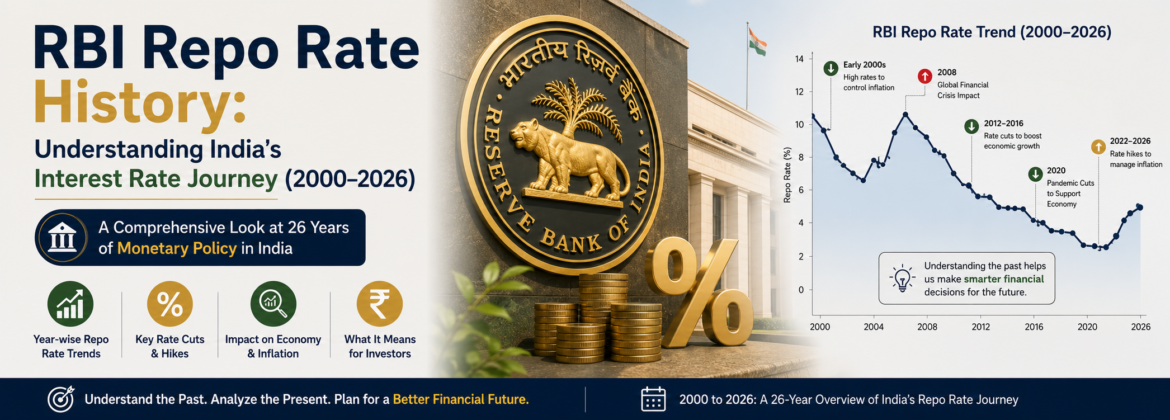
RBI Repo Rate History: Understanding India’s Interest Rate Journey (2000–2026)
The Repo Rate is one of the most important tools used by the Reserve Bank of India (RBI) to manage inflation, economic growth, and liquidity in the financial system. Every change in the Repo Rate impacts borrowing costs, home loans, business loans, fixed deposit rates, and overall economic activity.
Understanding the history of Repo Rate movements helps investors, borrowers, and financial planners make informed decisions. This article explores the RBI Repo Rate journey from June 2000 to June 2026 and its impact on the Indian economy.
“The Repo Rate influences everything from loan EMIs to investment returns, making it one of the most important indicators in the financial system.”
What is the Repo Rate?
The Repo Rate is the interest rate at which the Reserve Bank of India (RBI) lends money to commercial banks against government securities.
Why is the Repo Rate Important?
- Controls inflation.
- Supports economic growth.
- Influences home loan and personal loan interest rates.
- Affects fixed deposit returns.
- Impacts stock and bond markets.
- Regulates liquidity in the banking system.
Whenever the RBI changes the Repo Rate, banks generally adjust their lending and deposit rates accordingly.
Current RBI Repo Rate
Latest Repo Rate (June 2026)
5.25%
The RBI reduced the Repo Rate from 6.50% in early 2025 to 5.25% by April 2026, reflecting a more accommodative monetary policy stance.
RBI Repo Rate History: Major Phases
Phase 1: High Interest Rate Era (2000–2001)
High interest rates were used to control inflation and maintain financial stability.
- August 2000 – 16.00%
- August 2000 – 15.00%
- September 2000 – 13.50%
- October 2000 – 10.25%
Phase 2: Economic Stabilization (2002–2007)
As inflation moderated, the RBI gradually reduced interest rates.
- 2002 – 8.00%
- 2003 – Around 7.00%
- 2004 – 6.00%
- 2006–2007 – Gradually increased from 6.50% to 7.75%
Phase 3: Global Financial Crisis (2008–2009)
The RBI sharply reduced rates to support economic recovery.
- June 2008 – 8.00%
- July 2008 – 9.00%
- November 2008 – 7.50%
- December 2008 – 6.50%
- January 2009 – 5.50%
- April 2009 – 4.75%
Phase 4: Inflation Control Cycle (2010–2014)
As inflation increased, the RBI raised interest rates.
- March 2010 – 5.00%
- November 2010 – 6.25%
- January 2011 – 6.50%
- March 2011 – 6.75%
- January 2014 – 8.00%
Phase 5: Growth Support and Rate Cuts (2015–2019)
The RBI gradually reduced borrowing costs to support economic growth.
- January 2015 – 7.75%
- March 2015 – 7.50%
- June 2015 – 7.25%
- September 2015 – 6.75%
- April 2016 – 6.50%
- August 2017 – 6.00%
- June 2019 – 5.75%
- August 2019 – 5.40%
- October 2019 – 5.15%
Phase 6: COVID-19 Pandemic Response (2020–2021)
The RBI introduced emergency rate cuts to support the economy.
- February 2020 – 5.15%
- March 2020 – 4.40%
- May 2020 – 4.00%
The Repo Rate remained at 4.00% throughout 2020 and 2021.
Phase 7: Inflation-Fighting Cycle (2022–2024)
As inflation increased globally, the RBI aggressively raised interest rates.
- April 2022 – 4.00%
- May 2022 – 4.40%
- June 2022 – 4.90%
- August 2022 – 5.40%
- September 2022 – 5.90%
- December 2022 – 6.25%
- February 2023 – 6.50%
The Repo Rate remained at 6.50% throughout 2023 and 2024.
Phase 8: Easing Cycle Begins (2025–2026)
With inflation moderating, the RBI started reducing rates.
- February 2025 – 6.25%
- April 2025 – 6.00%
- June 2025 – 5.50%
- December 2025 – 5.25%
- February 2026 – 5.25%
- April 2026 – 5.25%
Highest and Lowest Repo Rates
Highest Repo Rate
- 16.00% on 9 August 2000.
Lowest Repo Rate
- 4.00% from May 2020 to February 2022.
How Repo Rate Changes Affect You
Home Loans
- Higher Repo Rate – Higher EMIs and borrowing costs.
- Lower Repo Rate – Lower EMIs and cheaper loans.
Fixed Deposits
- Higher Repo Rate – Better FD interest rates.
- Lower Repo Rate – Lower FD returns.
Mutual Funds
- Debt Mutual Funds generally benefit when interest rates decline.
- Lower interest rates can support long-term growth in Equity Mutual Funds.
Businesses
Lower borrowing costs encourage:
- Business expansion.
- Capital expenditure.
- Employment generation.
- Economic growth.
Key Takeaways from 26 Years of Repo Rate History
- Repo Rates have ranged from 4.00% to 16.00%.
- Economic crises often lead to interest rate cuts.
- High inflation generally results in Repo Rate hikes.
- Lower interest rates support economic growth.
- Monetary policy remains one of RBI’s most effective economic tools.
- Investors and borrowers should closely monitor RBI policy announcements.
Conclusion
The RBI Repo Rate plays a crucial role in shaping India’s economic landscape. Over the past two decades, it has moved between highs of 16.00% and lows of 4.00%, reflecting changing economic conditions, inflation trends, and growth priorities.
Understanding Repo Rate movements helps investors, borrowers, and financial planners make informed decisions regarding loans, fixed-income investments, mutual funds, and overall financial planning. As the economy evolves, RBI’s monetary policy will continue to influence interest rates and financial markets across India.
Keeping track of Repo Rate movements can help you make smarter borrowing and investment decisions for the future.
Connect With Us
Suresh Bhura
Truvestor Wealth
AMFI Registered Mutual Fund Distributor
Email: suresh@truvestor.net
Phone: +91 98311 19790
Disclaimer: This article is intended for educational and informational purposes only. Interest rates, monetary policy decisions, and economic conditions are subject to change. Investors should consult qualified financial professionals before making investment or borrowing decisions.
