
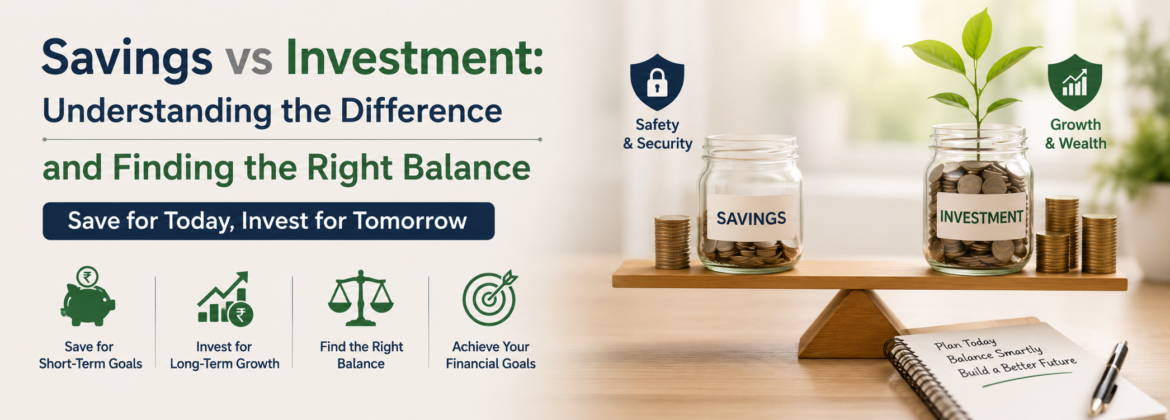
Savings vs Investment: Understanding the Difference and Finding the Right Balance
Many people use the terms saving and investing interchangeably. However, they serve different purposes in personal finance. While savings help you manage short-term needs and emergencies, investments help you build wealth and achieve long-term financial goals.
A strong financial plan requires both savings and investments. Understanding when to save and when to invest can significantly improve your financial future.
“Savings provide financial security, while investments create long-term wealth. A balanced approach is the key to financial success.”
The Ordinary Approach
Most people follow a simple financial pattern:
Income → Expenses → Savings
In this approach, people spend first and save whatever remains at the end of the month.
The Problem
Often, little or nothing is left to save after meeting expenses. This can delay wealth creation and make it difficult to achieve financial goals.
The Smart Approach
A more effective strategy is:
Income → Savings & Investments → Expenses
This follows the principle of “Pay Yourself First.”
Before spending on lifestyle expenses, a portion of income is set aside for savings and investments.
Benefits
- Builds financial discipline.
- Encourages regular investing.
- Helps achieve long-term goals.
- Creates wealth systematically.
- Reduces the temptation to overspend.
What Are Savings?
Savings refer to money kept aside for short-term needs, emergencies, and unexpected situations. The primary objective of savings is safety and liquidity rather than high returns.
Why Do We Need Savings?
- High liquidity when money is needed.
- High level of capital safety.
- Support during job or income loss.
- Financial protection during medical emergencies.
- Funds for vacations, celebrations, and other short-term expenses.
Where Should You Keep Your Savings?
- Cash.
- Savings Account.
- Bank Deposits.
- Liquid or Short-Term Debt Mutual Funds.
What Is Investing?
Investing means allocating money into assets that have the potential to generate higher returns over time. Unlike savings, investments are primarily aimed at long-term wealth creation.
Why Should We Invest?
- Beat inflation.
- Achieve long-term financial goals.
- Create wealth through compounding.
- Generate income after retirement.
- Create passive income opportunities.
Where Can You Invest?
- Mutual Funds.
- Stocks.
- Bonds.
- Real Estate.
- Commodities such as Gold and Silver.
- Other investment alternatives based on individual goals and risk appetite.
Savings vs Investment: Key Differences
Savings
- Purpose: Safety and Liquidity.
- Time Horizon: Short-Term.
- Risk Level: Very Low.
- Return Potential: Low.
- Accessibility: Immediate.
- Suitable for emergencies and planned short-term expenses.
Investment
- Purpose: Wealth Creation.
- Time Horizon: Long-Term.
- Risk Level: Moderate to High.
- Return Potential: Higher.
- Accessibility: Depends on the investment asset.
- Suitable for long-term financial growth and future goals.
Why You Need Both Savings and Investments
Savings and investments are not competitors—they complement each other.
Savings Help You
- Handle emergencies.
- Meet short-term goals.
- Maintain financial stability.
Investments Help You
- Build long-term wealth.
- Beat inflation.
- Achieve life goals.
- Create financial independence.
A healthy financial plan requires a balance between both.
How Much Should You Save?
A commonly recommended emergency fund is:
- Salaried Individuals: 6–12 months of expenses.
- Self-Employed Individuals: 12–18 months of expenses.
This provides financial protection against unexpected situations.
How Much Should You Invest?
Once emergency savings are in place, surplus funds can be invested based on:
- Financial Goals.
- Risk Appetite.
- Investment Horizon.
- Income Levels.
The earlier you start investing, the greater the benefit from compounding.
The Ideal Financial Formula
Step 1
Build an emergency savings fund.
Step 2
Protect yourself with adequate insurance.
Step 3
Invest regularly towards long-term financial goals.
Step 4
Review and rebalance your portfolio periodically.
This balanced approach helps create both financial security and long-term wealth.
Conclusion
Savings and investments serve different but equally important purposes. Savings provide security, liquidity, and peace of mind during uncertain times, while investments help create wealth, beat inflation, and achieve long-term financial goals.
The smartest approach is not choosing one over the other—it is balancing both effectively. By following the principle of “Save and Invest First, Then Spend,” individuals can build a strong financial foundation and move closer to financial freedom.
Balance your savings and investments wisely to secure today while building a better tomorrow.
Connect With Us
Suresh Bhura
Truvestor Wealth
AMFI Registered Mutual Fund Distributor
Email: suresh@truvestor.net
Phone: +91 98311 19790
Disclaimer: This article is intended for educational purposes only and should not be construed as financial or investment advice. Mutual Fund investments are subject to market risks. Please read all scheme-related documents carefully before investing.
