
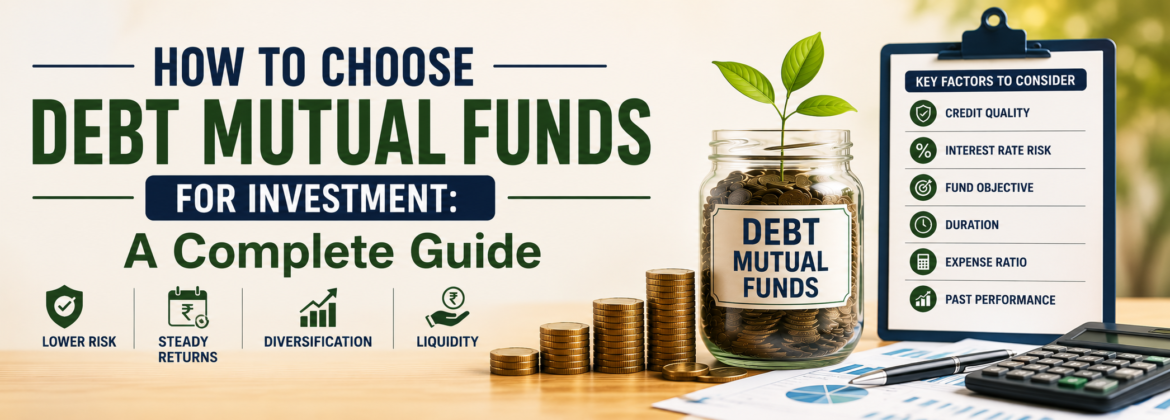
How to Choose Debt Mutual Funds for Investment: A Complete Guide
Debt Mutual Funds are often considered a suitable investment option for investors seeking stability, regular income, and lower volatility compared to equity mutual funds. However, choosing the right debt fund can be challenging because different categories serve different investment objectives.
Understanding your investment horizon, risk appetite, and financial goals is essential before selecting a debt mutual fund.
What Are Debt Mutual Funds?
Debt Mutual Funds primarily invest in fixed-income instruments such as:
- Government Securities
- Corporate Bonds
- Treasury Bills
- Certificates of Deposit
- Commercial Papers
- Money Market Instruments
The objective is to provide relatively stable returns, capital preservation, and lower risk compared to equity-oriented investments.
Why Invest in Debt Mutual Funds?
Debt funds can help investors:
- Preserve capital
- Earn regular income
- Diversify investment portfolios
- Manage short and medium-term financial goals
- Reduce overall portfolio volatility
Understanding Different Types of Debt Mutual Funds
Choosing the right debt fund starts with understanding the various categories available.
1. Overnight Funds
What They Invest In
Overnight securities with a maturity of just one day.
Suitable For
Investors looking for an extremely safe place to park money for a few days or weeks.
Risk Level
Very Low Risk
These funds have minimal interest rate and credit risk.
2. Liquid Funds
What They Invest In
- Treasury Bills
- Government Securities
- Certificates of Deposit
- Commercial Papers
with maturities up to 91 days.
Suitable For
Investors seeking liquidity while earning better returns than a savings account.
Risk Level
Very Low Risk
3. Ultra Short Duration Funds
What They Invest In
Debt and money market instruments with durations of 3–6 months.
Suitable For
Investors with a short investment horizon seeking slightly higher returns than liquid funds.
Risk Level
Low to Moderate Risk
4. Low Duration Funds
What They Invest In
Debt instruments with maturities between 6 and 12 months.
Suitable For
Investors seeking stable returns over a short-term period.
Risk Level
Low to Moderate Risk
5. Money Market Funds
What They Invest In
Short-term debt instruments and cash equivalents with maturities up to one year.
Suitable For
Investors looking for liquidity and safety with an investment horizon of up to one year.
Risk Level
Low to Moderate Risk
6. Short Duration Funds
What They Invest In
Debt instruments with durations of 1–3 years.
Suitable For
Investors with a short-to-medium-term horizon of more than one year.
Risk Level
Moderate Risk
7. Medium Duration Funds
What They Invest In
Bonds with durations of 3–4 years.
Suitable For
Investors with investment horizons of three years or more.
Risk Level
Moderate Risk
8. Medium to Long Duration Funds
What They Invest In
Bonds and securities with durations between 4 and 7 years.
Suitable For
Investors with investment horizons exceeding five years.
Risk Level
Moderate to High Risk
9. Long Duration Funds
What They Invest In
Government bonds, corporate bonds, and debentures with durations exceeding seven years.
Suitable For
Long-term investors willing to tolerate interest rate fluctuations.
Risk Level
High Interest Rate Risk
10. Dynamic Bond Funds
What They Invest In
Debt instruments across varying maturities based on the fund manager’s interest rate outlook.
Suitable For
Investors seeking active management and flexibility.
Risk Level
Moderate to High Risk
11. Corporate Bond Funds
What They Invest In
At least 80% in high-quality corporate bonds, generally AAA-rated.
Suitable For
Investors seeking regular income with relatively low credit risk.
Risk Level
Moderate Interest Rate Risk and Low Credit Risk
12. Banking & PSU Funds
What They Invest In
- Banks
- Public Sector Undertakings (PSUs)
- Public Financial Institutions
Suitable For
Investors seeking relatively safer debt investments.
Risk Level
Low Credit Risk and Moderate Interest Rate Risk
13. Gilt Funds
What They Invest In
Government securities only.
Suitable For
Investors seeking sovereign-backed investments.
Risk Level
Low Credit Risk but High Interest Rate Risk
14. Gilt Funds with 10-Year Constant Duration
What They Invest In
Government securities while maintaining an average duration of 10 years.
Suitable For
Investors with a strong view on declining interest rates.
Risk Level
Very High Interest Rate Risk
15. Credit Risk Funds
What They Invest In
Lower-rated corporate bonds offering higher yields.
Suitable For
Investors willing to take higher risk for potentially higher returns.
Risk Level
High Credit Risk
16. Floater Funds
What They Invest In
Floating-rate debt instruments where interest rates reset periodically.
Suitable For
Investors seeking protection against rising interest rates.
Risk Level
Low to Moderate Risk
Understanding Key Risks in Debt Mutual Funds
Credit Risk
The possibility that the issuer may fail to repay interest or principal on time.
Example
Lower-rated bonds generally carry higher credit risk.
Interest Rate Risk
Changes in interest rates affect bond prices and debt fund NAVs.
When Interest Rates Rise
- Existing bond prices fall
- Debt fund NAVs decline
When Interest Rates Fall
- Existing bond prices rise
- Debt fund NAVs increase
Funds with longer durations are more sensitive to interest rate changes.
Liquidity Risk
The risk that securities may not be easily sold when required.
How Interest Rates Affect Debt Funds
When Interest Rates Rise
- Older bonds become less attractive because newer bonds offer higher yields.
- Bond prices fall.
- Debt fund NAVs decline.
When Interest Rates Fall
- Existing bonds with higher coupon rates become more valuable.
- Bond prices rise.
- Debt fund NAVs increase.
Long-duration funds experience larger fluctuations than short-duration funds.
Choosing Debt Funds Based on Risk Profile
Conservative Investors
Suitable Categories:
- Overnight Funds
- Liquid Funds
- Ultra Short Duration Funds
- Low Duration Funds
- Money Market Funds
Ideal for very short-term goals and capital preservation.
Moderate Risk Investors
Suitable Categories:
- Short Duration Funds
- Medium Duration Funds
- Medium to Long Duration Funds
- Corporate Bond Funds
- Banking & PSU Funds
Ideal for investment horizons between 1 and 7 years.
Higher Risk Investors
Suitable Categories:
- Credit Risk Funds
- Dynamic Bond Funds
- Gilt Funds with 10-Year Constant Duration
Suitable for investors comfortable with higher volatility and longer investment horizons.
Taxation of Debt Mutual Funds
As per current tax regulations, debt mutual funds are generally taxed according to the investor’s income tax slab, irrespective of the holding period. Tax is payable upon redemption of units.
Investors should consult tax professionals for updated regulations and personalized guidance.
How to Choose the Right Debt Mutual Fund
What Is My Investment Horizon?
- Few days → Overnight or Liquid Funds
- Few months → Ultra Short or Low Duration Funds
- 1–3 years → Short Duration Funds
- 3–5 years → Medium Duration Funds
- 5+ years → Medium to Long Duration or Long Duration Funds
What Is My Risk Appetite?
Choose categories that align with your comfort level regarding volatility and risk.
What Is My Financial Goal?
Whether it’s emergency funds, short-term savings, income generation, or long-term stability, the objective should guide fund selection.
Final Thoughts
Debt Mutual Funds can be excellent investment vehicles when selected appropriately. The right choice depends on your financial goals, risk tolerance, and investment horizon.
Rather than chasing returns, focus on matching the debt fund category to your specific needs.
Remember:
- Match fund duration with your investment horizon.
- Understand credit and interest rate risks.
- Diversify appropriately.
- Review your portfolio periodically.
- Invest according to your financial goals.
Connect With Us
Suresh Bhura
Truvestor Wealth
AMFI-Registered Mutual Fund Distributor
 Email: suresh@truvestor.net
 Phone: +91 98311 19790
Disclaimer
Mutual Fund investments are subject to market risks. Please read all scheme-related documents carefully before investing. Returns are not guaranteed, and past performance is not indicative of future results. Investors should evaluate their financial goals, investment horizon, and risk appetite before investing and consult a qualified financial advisor for personalized guidance.
