
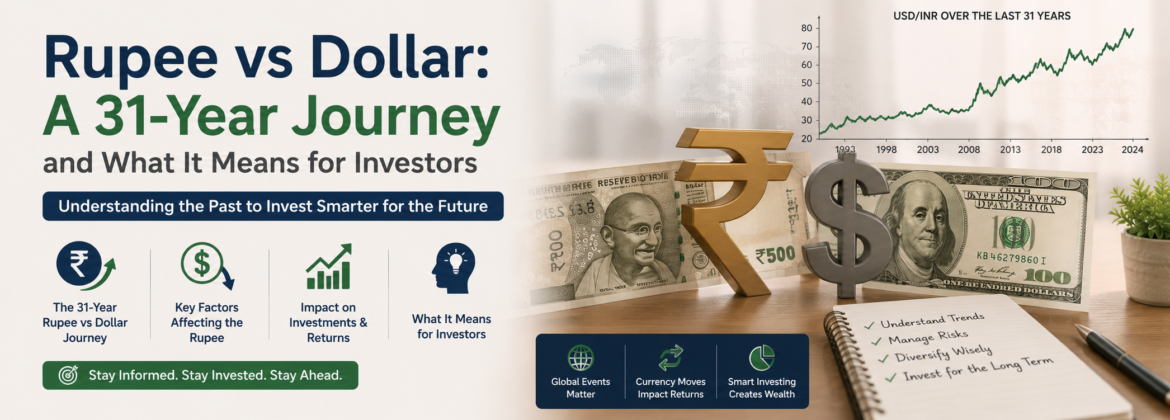
Indian Rupee vs US Dollar: Understanding 31 Years of Currency Depreciation
The Indian Rupee has witnessed significant changes against the US Dollar over the past three decades. While currency fluctuations are a natural part of every economy, understanding the long-term trend can help investors make better financial decisions.
A study of the USD/INR exchange rate from 1994 to 2026 reveals an important reality—over the long term, the Indian Rupee has generally depreciated against the US Dollar. This trend has implications for investors, importers, exporters, international travellers, and individuals planning for long-term wealth creation.
“Understanding currency trends helps investors protect purchasing power and make informed long-term financial decisions.”
Understanding Currency Depreciation
Currency depreciation occurs when a country’s currency loses value relative to another currency.
For example:
- 1994: 1 USD = approximately ₹31.
- 2026: 1 USD = approximately ₹90.
This means more Rupees are required today to purchase the same US Dollar.
31 Years of Rupee Depreciation: Key Findings
According to historical exchange rate data:
- Absolute Rupee Depreciation: 186.74%
- Annualized Depreciation (CAGR): 3.46% per year
These figures highlight the long-term weakening of the Indian Rupee against the US Dollar.
The Journey of the Rupee Against the Dollar
1994
- Exchange Rate: 1 USD = ₹31.38
- Value of $100: ₹3,138
2000
- Exchange Rate: 1 USD = ₹43.44
- Value of $100: ₹4,344
2010
- Exchange Rate: 1 USD = ₹46.62
- Value of $100: ₹4,662
2020
- Exchange Rate: 1 USD = ₹71.23
- Value of $100: ₹7,123
2026
- Exchange Rate: 1 USD = ₹89.97
- Value of $100: ₹8,997
The amount of Rupees required to purchase $100 has nearly tripled compared to 1994.
Why Does the Rupee Depreciate?
Several economic factors influence currency movements.
Inflation Differential
Higher inflation in India compared to the United States can gradually reduce the purchasing power of the Rupee.
Trade Deficit
India imports significant quantities of:
- Crude Oil.
- Electronics.
- Machinery.
- Technology Products.
Higher demand for US Dollars to pay for imports can put pressure on the Rupee.
Interest Rate Differences
Interest rate movements between countries influence foreign capital flows and currency values.
Foreign Investment Flows
Large foreign inflows may strengthen the Rupee, while capital outflows can weaken it.
Global Economic Events
Events such as financial crises, pandemics, geopolitical conflicts, and commodity price shocks can significantly impact currency markets.
Periods When the Rupee Strengthened
Although the long-term trend has been depreciation, there were several periods when the Rupee appreciated.
- 2004 – Approximately 5.03%
- 2005 – Approximately 4.82%
- 2008 – Approximately 10.65%
- 2010 – Approximately 4.38%
- 2011 – Approximately 4.27%
- 2018 – Approximately 6.55%
These periods demonstrate that currency movements are cyclical and influenced by changing economic conditions.
Major Depreciation Phases
Some years witnessed sharp declines in the Rupee.
- 2012 – Approximately 19.45%
- 2014 – Approximately 13.21%
- 2023 – Approximately 11.22%
These periods reflected heightened economic uncertainty and market pressures.
What Does Currency Depreciation Mean for Investors?
International Travel
Foreign travel becomes more expensive as more Rupees are required to purchase Dollars.
Overseas Education
The cost of studying abroad increases when the Rupee weakens.
Imports Become Costlier
Products such as electronics, luxury goods, fuel, and industrial equipment become more expensive.
Benefits for Exporters
Exporters may benefit because every Dollar earned converts into more Rupees.
Investment Planning
Global diversification can help reduce the impact of long-term currency depreciation on purchasing power.
Lessons for Long-Term Investors
Inflation Matters
Inflation and currency depreciation often move together over long periods.
Diversification is Important
A balanced portfolio may include:
- Equity Investments.
- Debt Investments.
- Gold.
- International Assets.
Focus on Real Returns
Evaluate investment returns after considering inflation and currency depreciation.
Think Long Term
Short-term currency movements are difficult to predict, but long-term trends provide valuable insights for financial planning.
How Investors Can Protect Purchasing Power
- Invest for long-term growth through equity-oriented investments.
- Maintain diversification across multiple asset classes.
- Review financial goals periodically.
- Consider international diversification for global financial goals.
Key Takeaways
- The Rupee has depreciated by approximately 186.74% against the US Dollar over the last 31 years.
- The annualized depreciation rate has been approximately 3.46% per year.
- Currency depreciation affects travel, education, imports, and investment planning.
- Diversification and long-term investing remain important tools for protecting purchasing power.
- Investors should focus on real wealth creation rather than nominal returns alone.
Conclusion
The history of the Indian Rupee versus the US Dollar provides an important lesson in long-term financial planning. While currency fluctuations are inevitable, the long-term trend highlights the importance of protecting purchasing power through disciplined investing and diversification.
Investors who understand inflation, currency depreciation, and the benefits of diversification are better positioned to achieve their financial goals. A well-balanced portfolio that combines growth, income, and global diversification can help preserve wealth despite changing economic conditions.
Focus on growing your purchasing power—not just your savings—to achieve long-term financial success.
Connect With Us
Suresh Bhura
Truvestor Wealth
AMFI Registered Mutual Fund Distributor
Email: suresh@truvestor.net
Phone: +91 98311 19790
Disclaimer: This article is intended for educational purposes only and should not be considered financial, investment, or tax advice. Currency markets are influenced by multiple economic factors, and past trends do not guarantee future outcomes. Investors should consult a qualified financial advisor before making investment decisions.
